
What Is Lyra (Aerial Hoop)? A Beginner's Guide
Lyra, also known as aerial hoop or aerial ring, is a metal hoop of steel or aluminum suspended in the air that an aerialist performs tricks on. These hoops can be suspended by ropes, silks, or a spanset and can be rigged in all manner of configurations, though they mostly hang from a single point.
Why Is It Called a Lyra?
According to Aerial Academy, "Lyra" comes from the fact that early versions of this apparatus were shaped like the musical instrument, the lyre, as creating a perfect circle of metal was a challenge at the time — as shown in this image of Fern Andra from the 1917 movie "Des Lebens ungemischte Freude." Of course, like much circus lore, the origin of the name is difficult to pin down, as exact sources of circus history can be tricky to come by — similar to what we found when looking at the history of aerial silks.
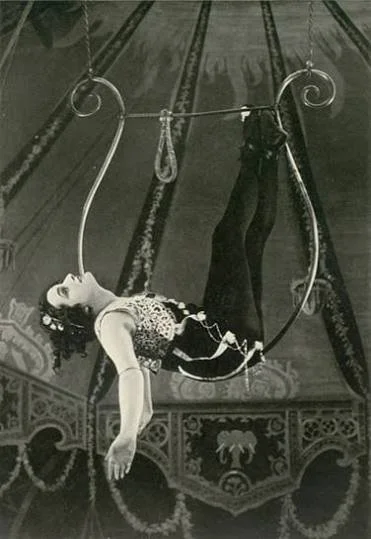
Fern Andra in the 1917 movie "Des Lebens ungemischte Freude."
What Is the History of Aerial Hoop?
This brings us to the history of aerial hoop, or lyra. A Medium article by Kim Barrett led us to an August 1893 edition of the New York Clipper, which advertised Ceado the Marvel, featuring him in his signature hoop. The sketch, as Barrett reports, is based on an image of Ceado sitting in his hoop. As you can see in the sketch, Ceado's hoop is quite a bit different from the lyra we typically see today — it's large, has a top bar in the middle, and has a lot more connection points to rigging than we usually see now.
So we know that Ceado was an early predecessor of the aerial hoop in the 1890s, yet another source credits Edward Van Wyck as the inventor of the aerial hoop. Van Wyck is well documented as the first person to create and sell retail juggling clubs; he also created a whole catalog of various props. However, we couldn't find specific evidence that he created the lyra or aerial hoop, so this may be a piece of circus history that's more speculation than fact.
What Kind of Tricks Can You Do on Lyra?
Lyra tricks can be broken into a few categories: poses, drops, and rolls. Poses are just what they sound like — a relatively static shape that you make in and around the hoop with your body. Drops are when you move rapidly from one shape to another, typically with a moment of controlled fall; these include moves where the aerialist drops from the top bar to the bottom bar, as well as the aerialist creating a wrap in the spanset and then unrolling. Finally, rolls are when the aerialist moves in a circular motion around the bar; popular ones include snake rolls, hip circles, and elbow circles.
Does Lyra Hurt?
Well, it's not affectionately called the "bruise circle" for nothing. Yes, Lyra can be uncomfortable and it can bruise, but as your skill increases you'll find it gets more comfortable and you bruise less in the basic shapes.
Do I Need to Be Flexible?
The truth is that flexibility does help with aerial, whether it's Lyra or another apparatus, but that does not mean you need to walk into your first class with a perfect split or backbend. Flexibility is a skill just like everything else, and it comes with time. There are many, many things you can do on Lyra that don't require flexibility.
Do I Need to Be Able to Do a Pull-Up?
Absolutely not! Like we said with flexibility, strength comes with time and work. Come as you are and you'll be surprised how fast you grow.
How Do I Get Started?
Roustabout offers two beginner lyra classes in Denver, one on Mondays and one on Wednesdays. If you're coming with some experience, we also have intermediate lyra and advanced lyra on other days of the week. View the full class schedule here.
